
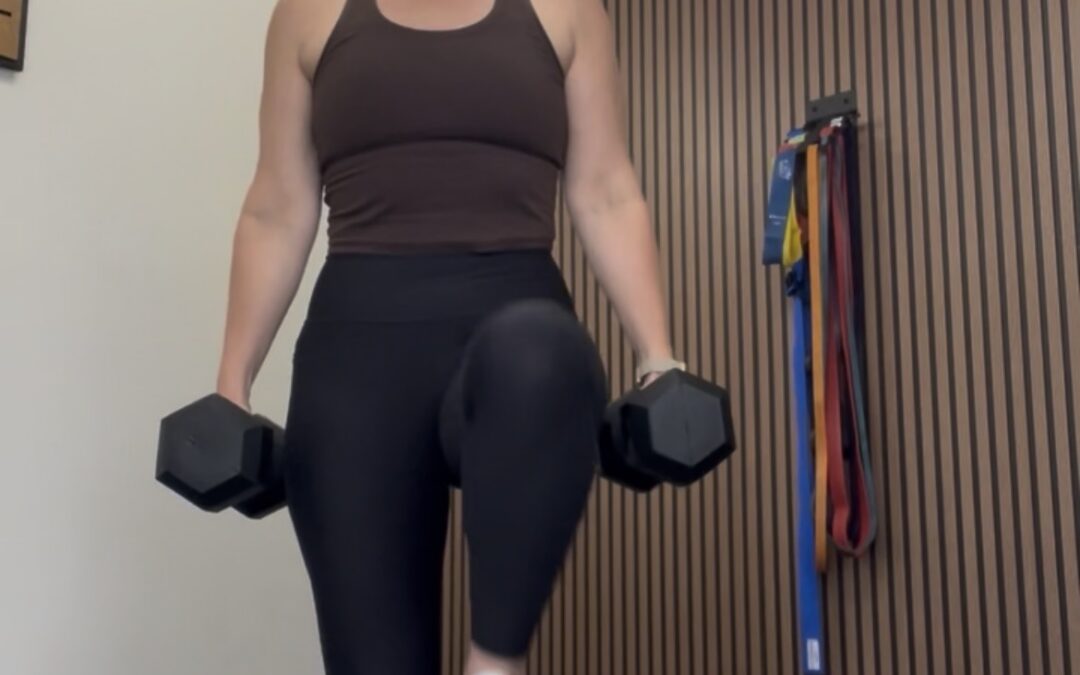
Loaded carries might be one of the least exciting-looking exercises in the gym.
You pick up something heavy. You walk. You put it down.
But despite their simplicity, carries are one of the exercises I use with almost every type of client—from someone rebuilding strength after an injury to a runner, parent, recreational athlete, or experienced lifter.
Why? Because carries train your body to do something it needs to do every day:
Create strength and stability while you move.
What Is a Loaded Carry?
A loaded carry involves holding a weight in a specific position while standing or walking. The weight might be held:
- At both sides during a farmer carry
- On one side during a suitcase carry
- At the shoulders during a front-rack carry
- Overhead during an overhead carry
Changing where and how you hold the weight changes the demand placed on your grip, shoulders, trunk, hips, and overall movement strategy.
Research has shown that loaded carries activate the trunk musculature while the body is moving and can challenge the core differently depending on whether the load is held with one arm or both.
Why Carries Are So Effective
They Train Your Entire Core
Your core is more than just your abdominal muscles. It includes your diaphragm, abdominals, obliques, spinal muscles, and pelvic floor working together to create and manage pressure.
During a carry, your trunk must resist being pulled forward, backward, or sideways by the weight. Instead of repeatedly bending through your spine, you are asking your core to maintain a strong position as your arms and legs move around it.
This is especially noticeable during a suitcase carry. Because the weight is held on only one side, your trunk must resist leaning toward it. Your obliques, hips, and other stabilizing muscles work together to keep you upright and moving efficiently.
They Build Practical Grip Strength
Carries train what is sometimes called a supporting grip: your ability to hold onto an object for time or distance.
That strength can carry over to tasks such as:
- Carrying groceries
- Holding a child
- Moving luggage
- Carrying equipment
- Performing deadlifts, rows, and pull-ups
- Handling heavier objects around the house
Holding a load while moving is an established method of developing supporting grip strength, while also closely resembling the types of carrying tasks we encounter outside the gym.
They Connect the Upper and Lower Body
Your body does not function as a collection of isolated muscles.
When you walk with a weight, your feet interact with the ground, your hips control your pelvis, your trunk manages the load, and your shoulder and hand maintain the weight’s position.
Carries require all of those areas to work together. That makes them a useful bridge between isolated rehabilitation exercises and the more complex demands of life, work, running, lifting, and sport.
They Challenge You Without Requiring Complicated Technique
Carries can be demanding without being overly complex.
They do not require a long list of steps or a highly technical movement pattern. The load, position, distance, speed, and duration can all be adjusted to meet the person where they are.
A carry might begin with a lighter weight for a short distance. Over time, it can be progressed by:
- Increasing the weight
- Walking farther
- Slowing down
- Adding marching or pauses
- Changing the position of the weight
- Carrying different loads on each side
Simple does not mean easy—and it definitely does not mean ineffective.
Four Carry Variations to Try
1. Farmer Carry
Hold one weight in each hand with your arms relaxed by your sides.
This is a great starting point for developing overall strength, grip endurance, and trunk control.
Think: Stand tall, keep your ribs stacked over your pelvis, and walk normally.
2. Suitcase Carry
Hold a weight in one hand, as though you are carrying a suitcase.
The one-sided load creates an additional challenge for your obliques, hips, and trunk because your body must resist leaning toward the weight.
Think: Stay tall and avoid shifting away from or collapsing toward the weight.
3. Front-Rack Carry
Hold one or two weights near the front of your shoulders.
This position increases the demand on your upper back, trunk, and breathing strategy because the weight sits in front of your body.
Think: Keep the weight close, avoid excessively arching your back, and continue breathing.
4. Overhead Carry
Hold a weight overhead while walking.
This variation requires adequate shoulder mobility, strength, and control. It is generally a more advanced option and may not be the best starting point for everyone.
Think: Reach tall without shrugging excessively or allowing your ribs to flare forward.
How Heavy Should You Go?
The right weight depends on the purpose of the exercise.
Some carries are programmed heavier and shorter to emphasize strength. Others use a more moderate load over a longer distance to challenge endurance and positioning.
A useful load should feel challenging while still allowing you to:
- Maintain an upright position
- Walk with control
- Keep breathing
- Avoid gripping or bracing harder than necessary
- Complete the planned distance without your form significantly changing
You should not have to hold your breath, lean dramatically, or race to the finish line just to complete the exercise.
Carries in Physical Therapy
Carries can be valuable during rehabilitation because they are easy to customize and can gradually expose the body to real-world demands.
Depending on the person and their goals, they may be incorporated into treatment for:
- Returning to lifting or exercise
- Improving trunk and hip control
- Rebuilding tolerance for carrying a child
- Preparing for work-related demands
- Progressing shoulder loading
- Improving confidence under load
- Transitioning from rehabilitation into performance training
The exercise itself is not the entire treatment plan. The value comes from choosing the appropriate carry, position, load, and progression for the individual in front of us.
The Bottom Line
Carries may look basic, but they train something incredibly important: your ability to manage load while moving.
They challenge your grip, shoulders, core, hips, posture, coordination, and conditioning—all within one straightforward exercise.
They are not flashy. They are not complicated.
But they are incredibly useful.
Carries are underrated—and there is a reason they show up in so many of my clients’ programs.
At Redefine Physical Therapy & Wellness, we use personalized strength and movement training to help you bridge the gap between rehabilitation, everyday life, and the activities you love.
Whether your goal is to return to exercise, lift with more confidence, keep up with your kids, or simply feel stronger in your daily life, we meet you where you are and build from there.
References
Ellestad SH, et al. The Quantification of Muscle Activation During the Loaded Carry and Hold Exercises. 2024.
McGill SM, et al. Trunk Muscle Activation and Lumbar Spine Motion, Load, and Stiffness. 2009.
National Strength and Conditioning Association. Core Strength and Functionality With Loaded Carries.